Two industries, one skip: Why Events and Film are fighting the same sustainability challenge.
When a film wraps and throws away the same custom-built timber sets as a three-day trade show, we’re not looking at two different industries; we’re looking at a failure in resource management that applies to both temporary systems.
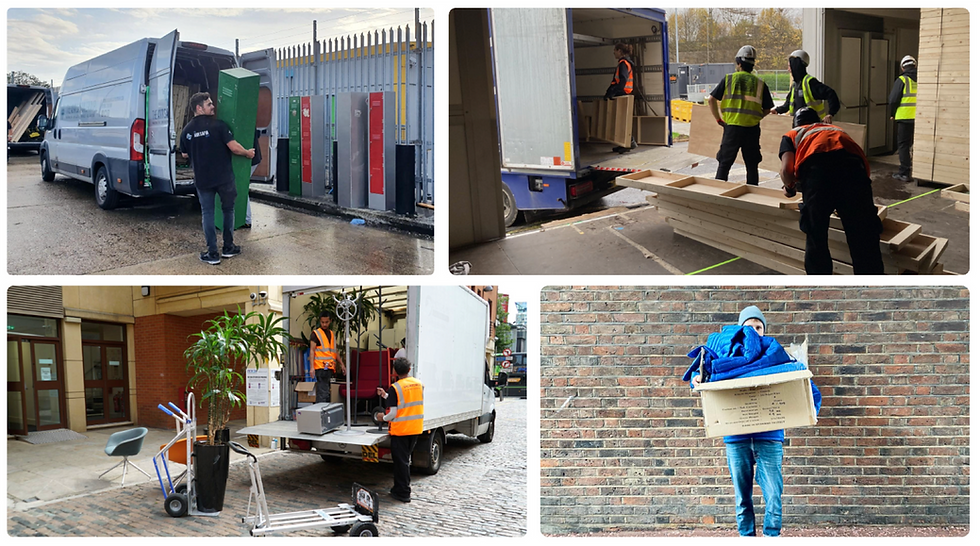
LPE: Custom-built timber film sets. Event Cycle: Custom-built timber event sets.
Within film, this often shows up as a kind of “circus mindset”, where productions arrive, build what they need, and move on just as quickly. The focus is on delivering what is required in the moment, with far less attention given to what happens afterwards. Sets and materials are treated as temporary by default, rather than as part of an ongoing lifecycle.
At the surface level, a high-end film production and a global corporate conference and exhibition don’t have much in common. Beautiful moving images are being chased by one, and product and service sales are chased by the other. But behind the scenes, there’s a similar pattern; idling generators, crew catering, location selection, production schedules, prop building and a long list of suppliers transporting AV kit, clothing crew and pieces of set. And within all this are inevitably items which end up being single-use, sometimes through no fault of the teams and sometimes through poor planning. Assets that are considered waste once the cameras stop rolling or the conference centre doors close.
In many cases, this is not a deliberate choice but a reflection of how productions operate. Crews work under pressure, timelines are tight, and sustainability is not always something people have the time to fully engage with. Without a clear understanding of its value, it is easy to assume that more sustainable approaches will add complexity or cost, and so familiar ways of working tend to prevail. The secret lies in shifting to a circular mindset from the start; it’s better for production and better for the planet. If you are planning for a strike from the beginning, then you are designing your sets in a way that it’s easier to strike them - different material, modular set build, etc; this enables the construction company to disassemble it quickly. That’s important for the production, as often location agreements and studio costs dictate a super-fast turnaround time, so if this is tackled from the beginning, there’s no rush at the end to just ‘chuck it on a roll-on’ to be able to ‘get out on time’.
Both industries currently tackle sustainability in silo thinking their set-up is different from that of an event, but when the equipment and logistics are laid out without the shows on top, the industries look very much the same. A generator on set is the same as one powering a tent in a field at a festival.
There is also an underlying issue of knowledge and confidence. In a fast-paced environment like film, people rely on established practices, and change can feel risky. This is where external guidance becomes important. Sustainability specialists can support productions in understanding how decisions connect across departments, and how early adjustments can reduce impact without disrupting the process. They can also provide resources and knowledge from previous instances, speed up the process and ease the daunting step of going down a ‘new’ path.
As with most things in life, the film and event industries have far more in common than that which divides them. Whether it’s a 72-hour event or a 6-month shoot, the core sustainability elements, transport, energy use, materials, and logistics, apply across all creative work. By treating these as isolated fields, we miss the chance to share the solutions that are already working.
In film, however, these elements are often only addressed once production is already underway. Whether sustainability succeeds or fails is usually determined at the point a project is greenlit. Decisions around budget, suppliers, locations, and materials are made early, and if sustainability is not part of those conversations, it becomes much harder to introduce it later in a meaningful way. When it is built in from the beginning, it can carry through far more effectively.
Temporary worlds, shared structures
Both industries are masters of building temporary production worlds. We create film sets, stages, and installations that exist for a heartbeat but require substantial resources to build and operate.
Adidas GB kit retail event
While the timelines differ, events are a high-speed sprint while film is a marathon; the operational components are identical. We both manage mobile crews, large-scale catering, complex lighting, and temporary infrastructure under tight deadlines. These parallels mean that a sustainability strategy developed for a film set can often be mapped directly onto an event.
One area that still feels underdeveloped in film is what happens after a production finishes. In the event space, there is often more emphasis on storing and reusing materials. Film, by comparison, tends to start from scratch each time. Yet many sets and builds could be adapted, reused, or passed on with relatively little effort. With the right structures in place, there is clear potential to extend the life of these resources. However, it requires a shift in mindset, in design, in asset and IP management - there are multiple layers to this, which, if considered early on, are really worth adopting.
Connecting the dots across the industries
Unit Base Hybrid Generator 2
Because the underlying challenges are so similar, there is an opportunity for shared practices. Sustainability coordinators are in a unique position to help connect those practices. For example:
Diesel-free blueprints: Successes in diesel-free film production offer a roadmap for greenfield event sites to eliminate fossil fuel generators. Leverage Point Entertainment achieved 95.6% diesel-free operations on a recent production, providing a practical model for both industries.
Preventative procurement practices: Event Cycle has worked with major events to track purchasing decisions right from the beginning to follow the lifecycle of every asset, ensuring reuse opportunities can be identified before doors open to the audience.
Asset afterlife: In 5 years of business, Event Cycle has converted over £3.2 million in surplus event materials into social value. This Asset Dissolution doesn’t just work at events; it’s the perfect solution for film wraps looking to avoid the skip and create a local social legacy instead. In our productions, we ensure sets, props, and materials find a second home through donation, giving assets continued life beyond wrap.
Story-led data: We’ve learned that tonnes of CO2 is too abstract. By visualising impact with stories from charities supported, we give both film producers and event organisers a story they can share with their audience.
What is notably absent is a consistent approach to sharing resources across productions. Materials are often held within a single project and rarely circulate beyond it. Introducing systems for internal donation or reuse within the industry could significantly reduce waste. While this would require coordination and clear processes, the benefit of reusing existing builds rather than repeatedly creating new ones is difficult to ignore.
The opportunity for Innovation
Cop26-blue-zone-globe
The creative sector influences culture and behaviour. When we rethink how productions are designed and delivered, we are doing more than lowering our carbon footprint; we are providing the foundation to shape industry standards and inspire our audiences.
If we can solve the sustainability problems for a 48-hour event de-rig, we can solve it for a complex film wrap, too. The logistics are comparable, the community need is identical, and the potential for innovation is endless.
There are also wider implications for the industry. Sustainability is increasingly linked to funding, partnerships, and long-term resilience. Productions that do not adapt may find themselves at a disadvantage, not only environmentally but commercially. Expectations are shifting, and sustainability is beginning to sit less as an added consideration and more as a baseline requirement.
Sustainability isn't a department within your industry; it’s a shared standard across the entire creative sector. By breaking down the barriers between film and events, we can stop reinventing the wheel and start sharing the solutions instead.
Top tip: The next time you’re planning a production, don't just look at your own industry’s guidelines. The solution to your biggest sustainability challenge has likely already been solved by a colleague in another field.
The opportunity lies in moving beyond recognising these overlaps and beginning to act on them more consistently. Many of the solutions already exist across both industries. The challenge is to apply them earlier, share them more openly, and embed them as part of standard practice rather than treating them as secondary considerations.
Event Cycle Leverage Point Entertainment
Work with us today:
Looking for sustainability support for your event, production, or film project?
Event Cycle: hello@eventcycle.org
Leverage Point Entertainment: greenlight@leveragepointent.com